

$10.00 Original price was: $10.00.$8.00Current price is: $8.00.
24 in stock
Type: Believed to be Smyrna Type (May Require Pollination)
NBS 13-1 is a rare Eastern European fig variety introduced through Vlad and originally sourced from a Ukrainian gardener. After evaluating the tree and its fruit, Vlad assigned it the designation “NBS 13-1,” and it has since gained interest among collectors for its exceptional vigor and outstanding fruit quality.
While the exact identity and history of the variety remain somewhat mysterious, the tree has demonstrated remarkable growth characteristics. Growers consistently note its extreme vigor, making it one of the fastest-growing and most robust fig varieties in cultivation.
The tree develops strong shoots, large healthy foliage, and an impressive growth rate once established. This vigorous nature makes it particularly attractive for growers seeking rapid establishment and strong production potential.
The fruit is highly regarded for its sweetness and eating quality. Growers describe the figs as exceptionally sweet, rich, and delicious, producing fruit that stands out even among premium collector varieties. The flavor develops fully when fruit is allowed to ripen completely on the tree.
While complete fruit descriptions are still being gathered as more growers evaluate the variety, the eating quality has consistently received positive reviews from those fortunate enough to grow and taste it.
Current observations suggest NBS 13-1 may be a Smyrna-type fig. If this proves correct, fruit production may require pollination by the fig wasp to achieve full ripening. Because the pollination requirements have not been fully confirmed in all growing regions, growers should consider this variety potentially pollination-dependent.
For growers located in areas where the fig wasp is present, NBS 13-1 may offer the opportunity to grow a unique and exceptionally flavorful fig with outstanding vigor and productivity.
As more growers evaluate the variety, additional information regarding fruit characteristics, productivity, and pollination requirements will continue to emerge.
Its combination of Ukrainian origins, exceptional vigor, outstanding sweetness, and collector rarity has helped establish NBS 13-1 as a fascinating variety for serious fig enthusiasts.
For collectors seeking a rare Eastern European fig with exceptional growth and highly praised fruit quality, NBS 13-1 is an excellent addition to any collection.
USDA Zones 7-10
Important: NBS 13-1 is currently believed to be a Smyrna-type fig. Smyrna figs typically require pollination by the fig wasp in order to produce mature fruit. Growers outside fig wasp regions should purchase with the understanding that pollination requirements have not been fully verified in all climates.
Don’t let the growing zones discourage you. Fig trees can be successfully grown in containers and many growers enjoy growing rare varieties well outside their recommended zones. Growing in a pot allows you to move the tree to a protected location during winter and control its size.
During the winter months, cuttings will typically be fully dormant.
During the fall, cuttings may still be lignified (hardened woody growth) and may not yet be fully dormant. This is normal and does not affect their ability to root.
Wood color, thickness, bud spacing, and appearance will naturally vary from cutting to cutting. Certain varieties naturally produce thinner or thicker wood than others.
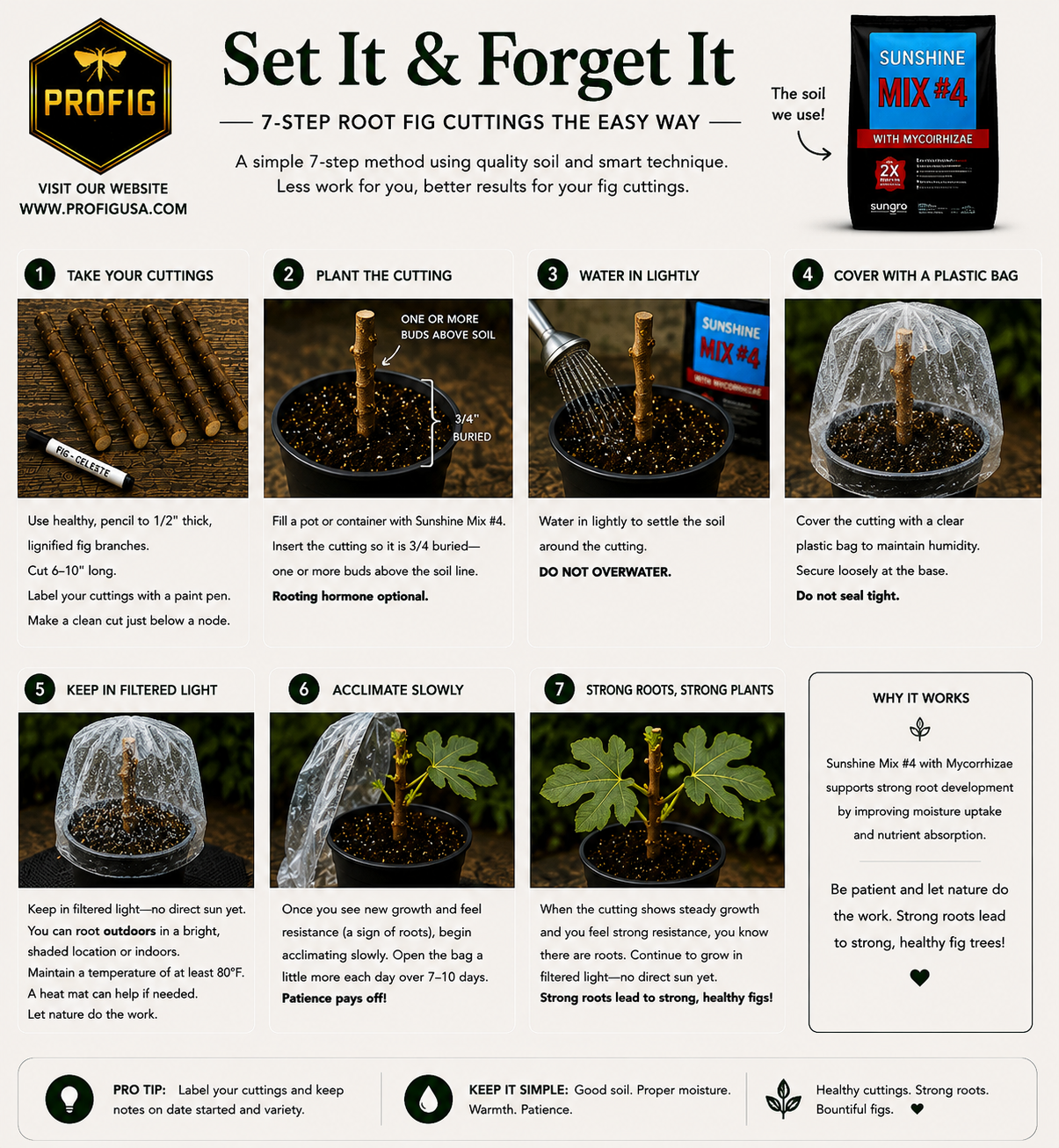
Rooting instructions are included in the listing photos. Please review them before purchasing.
Rooting success depends on many factors including temperature, humidity, rooting method, growing medium, sanitation, and grower experience.
While fig cuttings are generally considered easy to propagate, no rooting success can be guaranteed. Even experienced growers may experience occasional losses.
Most growers can expect a rooting success rate of approximately 60% to 80% under proper conditions. Individual results may vary.
Because rooting conditions are beyond our control after delivery, we cannot offer refunds, replacements, or credits for cuttings that fail to root.
Cuttings are carefully packaged to help ensure they arrive in excellent condition.
Thank you for supporting ProFig.
Only logged in customers who have purchased this product may leave a review.


Reviews
There are no reviews yet.